TORN is a weekly online faith discussion group on Zoom focused on religion, philosophy, and critical thinking. Join open conversations designed to challenge ideas and pursue truth.

Training Christians shoulder-to-shoulder through rigorous Bible study, apologetics, and evangelism.
TORN is a weekly online faith discussion group on Zoom focused on religion, philosophy, and critical thinking. Join open conversations designed to challenge ideas and pursue truth.
Does it seem to you like words are beginning to lose their meaning in our society? This trend was noticed by the Christian intellectual giants Francis Schaeffer and Walter Martin.
On March 28th at 10:00am CT I’ll give a recorded presentation and then a discussion to follow.

This is the second part of our rigorous Bible study of Romans, my favorite book of the Bible!
In this study we’re zooming in on Romans 2:6-11, but we are more broadly considering the first three chapters of Romans.
By the end of this second part of our study, I hope you will be able to share a taste of the “AHA!” moment I had while meditating on these verses. When you tug on the thread of Romans 2:6-11, you really do begin to unravel the message of the entire Bible!

Was the Fall of Adam and Eve a blessing or a tragedy? In my recent video, I explore how the Church of Jesus Christ of Latter-day Saints (LDS) teaches that the Fall was a good and necessary event — and why, from a biblical perspective, that view contradicts Scripture’s message about sin and salvation.
Join me as I delve into the themes and theology presented during the April 2025 General Conference of The Church of Jesus Christ of Latter-day Saints, including the emphasis on an inner testimony, the role of authority in the church, and intriguing discussions surrounding the church’s soteriology (teachings on salvation).
Join me for an in-depth, verse-by-verse study through Romans 1:18–32, the powerful passage where Paul reveals the truth about human nature, sin, and God’s righteous response.
In this first part of our Romans Series, we explore key themes in Christian anthropology (what the Bible teaches about humanity) and epistemology (how we know truth about God). Together, we’ll unpack how God’s grace reaches a fallen world—and the deep consequences when humanity rejects His truth.
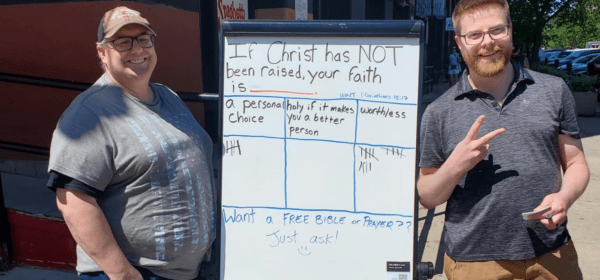
Written by my friend, Neil, who joined me and one other friend for some whiteboard/conversational evangelism at the Downtown Omaha Farmer’s Market recently. He felt led to share his recollections of the day. I hope this gives you a glimpse into the work we do and you are encouraged by how many people you are able to reach by asking simple, conversational questions.
![Ecce Homo ("Behold the Man") by Antonio Ciseri [1871], Pontius Pilate presenting a scourged Jesus to the people of Jerusalem](https://nametheunknown.com/wp-content/uploads/2025/05/ecce_homo_by_antonio_ciseri_1-thumbnail.png?w=600&h=280&crop=1)
Here’s one of my favorite Bible verses and why it is great to use in evangelism! I will explain I) how this verse disagrees with spirituality according to modern Western culture, II) how, interestingly, it shows atheists get something right, and III) how it is a forceful apologetic for Christianity.
Evangelism tips to better equip you to proclaim the faith of Christ to others. Learn how to ask clarifying questions to push the conversations into deeper waters.

Join me in this enlightening study where I present the results of my six-month study on the beliefs of Jehovah’s Witnesses, particularly their perspective on Jesus Christ. This analysis contrasts their views with the Biblical narrative, especially regarding Jesus’ involvement in the creation of the universe and the discussion of his nature as either created or uncreated. This in-depth research is my most extensive to date and is intended for Christians eager to deepen their understanding of their faith, as well as those interested in the principles of hermeneutics and Biblical interpretation. Discover the complexities of competing interpretations with me.

We are doing whiteboard/conversational evangelism and handing out gospel tracts at the Old Market twice monthly through October. These are such encouraging and edifying times, I hope you’ll consider joining if only to be a prayerful bystander.

Myself and 2 others will share our experience of a recent mission trip to Utah to evangelize the Mormons.
I’ve been meeting with one of Jehovah’s Witnesses regularly. It’s been fun, he’s trying to convert me to his worldview and I’m praying he turns to the Biblical Christ.
I asked him, “If the leaders of your organization (the Watch Tower Bible and Tract Society) announced…

Keeping our definitions of “perfect” in mind, we can now look at all the Bible passages relevant to Christian perfection. I have organized the passages under commands and teachings. I have given a very brief summary in my own words of the passage as it relates to perfection.

I was about to post a Tweet claiming “perfectionism is a sin” and “scripture doesn’t command us to be perfect”. I thought that sounded very reassuring, wise, and thought-provoking. Well, it turns out, the Bible commands us to be perfect! I thought, “what in the world is that supposed to mean?”

Kepler, who described for us the laws of planetary motion, understood that his work in math and science was not a game. In numbers, shapes, and planets, he was dealing with the mind and creation of God. He was examining, discovering, and describing things God saw fit to breath into existence.

Given that I’ve recently begun teaching science and math, I thought it would be relevant to pick up Newton’s Gift by David Berlinski from my bookshelf. It is a short biographical work on Isaac Newton focusing on his intellectual contributions and pursuits.
Does the Bible condemn homosexuality? Is it a sin to be gay? Here’s every Bible passage that is directly relevant to these questions.

Jim mentioned to me recently that he’s been looking into Bible study software to aid in the efficiency of his ministry. Logos Bible Software seems to be the superior tool for his needs. I know the cost of that resource would be a burden to him and his wife, both of whom are retired. I want to heed the Apostle Paul’s admonish in his letter to the Galatians that “The one who is taught the Word is to share all good things with the one who teaches him.”

My brother and I went through Surprised by Hope by N.T. Wright to celebrate Easter last year. The book is essentially a reminder (to some, a surprising revelation) that God’s plan for His people is not for us to float around as disembodied souls playing harps for eternity. His plan is to change everything, to make the physical and the spiritual world new, uniting the two.

I looked at every use of the word “spirit” in the New Testament to doe examine every instance in which someone received the Holy Spirit and tally which of these additional elements above were present. I also examined every passage which taught about the Holy Spirit, especially looking for any passage teaching on what elements must be present for the receipt thereof.
Happiness is what happens based on our circumstances in this world. In contrast, joy is knowing God is in control. There is not necessarily happiness in all circumstances, but there can be joy within all circumstances. Christ taught that we would experience persecution, but whatever happens, God has made you to meet the challenge.

The apostle Paul commands his readers to “be anxious for nothing”. Whoa. Is that what he really means? The topic of this sermon is hermeneutics, which is a fancy word for “how to understand and apply a text”. The term is most often used in the context of the Christian Bible; however, you can apply hermeneutics to any text. There are LOTS of commands (in other words, direct instructions) in scripture. How can Christians know which commands apply to them and which don’t?

It seems to me that most colleges, especially public colleges, are no friendly environment for Christians any longer. There are just too many contradictions between the Christian worldview and the secular, liberal worldview that is predominant in those institutions. So how can young Christians find a safe and healthy community to hang with when they leave home and find themselves in a liberal college setting?

How do Christians live in and respond to the world they live in but aren’t a part of spiritually? It’s God who puts governments and rulers in power, right? Does this mean President Joe Biden is in power because God gave him that power? If we disagree with the way our government is doing things, what should the Christian response be?
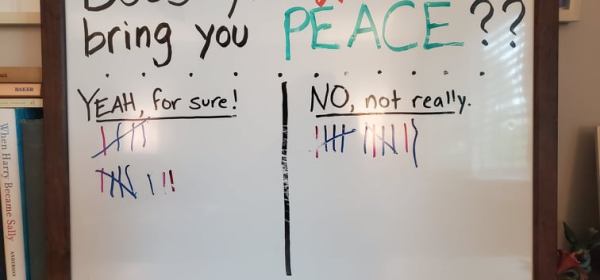
Last month, I went to Downtown Omaha’s Old Market interested in a very specific question for anyone who cared to talk with me: DOES YOUR WORLDVIEW BRING YOU PEACE? Here’s how you can answer that question.

In this interview I ask my long-time friend and mentor, Jim Shaul (whose sermons have been posted regularly on this site) to give his advice to someone who realizes they should give religion more serious consideration. For those folks, my hope is for them to stumble across this interview and come away with some options for next steps.

The Book of Mormon is not the primary source of Mormon doctrine, contrary to popular belief. Here is a brief overview of the most important Mormon texts and links to reading them online for free.

America has hit a historical number in a recent Gallup poll. For the first time ever, the majority of Americans do not belong to a church, synagogue, or mosque. Only 47% are part of such a religious community. What stood out to me more than the percent of Americans who attend church was the percent of people who claim to be religious but don’t belong to a religious community.

Is it wrong to love being right? I believe any attempt to learn and promote truth will be met in modern society with some suspicion. This post is a survey of some facts about being right that may surprise those living in a society influenced by postmodernism. These apply not only to people who love being right about religion specifically, but about those who love being right in general.

As I begin this public journey to grow in truth about religion, I and anyone who wishes to join me would do well to remember finding things out can sometimes be a “nasty dangerous business.”
 Name the Unknown