
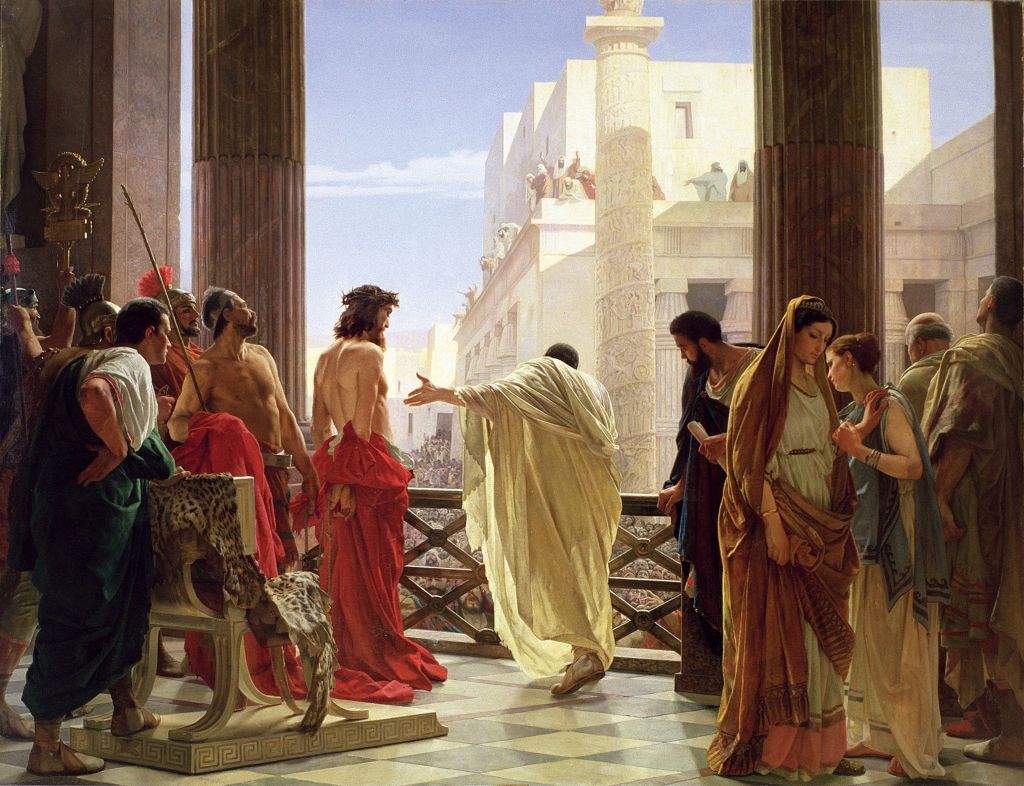
![Ecce Homo ("Behold the Man") by Antonio Ciseri [1871], Pontius Pilate presenting a scourged Jesus to the people of Jerusalem](https://nametheunknown.com/wp-content/uploads/2025/05/ecce_homo_by_antonio_ciseri_1-thumbnail.png?w=840)
[This post is adapted from my recent video below.]
Let’s talk about one of my favorite Bible verses and why it is great to use in evangelism! I will explain I) how this verse disagrees with spirituality according to modern Western culture, II) how, interestingly, it shows atheists get something right, and III) how it is a forceful apologetic for Christianity. This post is both to train Christians who are sharing their faith and for non-Christians who are curious about the claims of the Bible. Let’s get into it!
I’m part of a small group of Christians who do evangelism in Omaha’s Old Market and we’re going to use this verse as a worm to fish with. We’ll have this verse on a whiteboard and ask people to guess how it ends. Here are the three options:
1 Corinthians 15:17 says: “If Christ has not been raised, your faith is…”
- Up to personal choice
- Holy if it makes you a better person
- Worthless
The right answer is “WORTHLESS”! I think that will surprise some people.
The Apostle Paul wrote this to a church in the Roman province of Corinth. He spends much of chapter 15 correcting some of his audience who had been denying that the that all believers will be resurrected with incorruptible bodies. Here’s some more context to this verse:
“Now if Christ is preached, that He has been raised from the dead, how do some among you say that there is no resurrection of the dead? But if there is no resurrection of the dead, then not even Christ has been raised; and if Christ has not been raised, then our preaching is in vain, your faith also is in vain. Moreover, we are even found to be false witnesses of God, because we testified against God that He raised Christ, whom He did not raise, if in fact the dead are not raised. For if the dead are not raised, then not even Christ has been raised; and if Christ has not been raised, your faith is worthless; you are still in your sins. Then also those who have fallen asleep in Christ have perished. If we have hoped in Christ only in this life, we are of all people most to be pitied.” [1 Corinthians 15:12-19]
WOW. What a raw and honest passage.
I.
Here’s the first reason why 1 Corinthians 15:17 is such a great verse to use in evangelism:
It proves that the Bible disagrees with so much of how modern Westerns think about spirituality.
The Apostle does not sound the way most people in our culture sound when they talk about spirituality. You often hear phrases such as “you have your truth, I have mine”, “if your religion makes you a better person, then go for it”, or “all spiritual paths lead to the same place”.
The problem is my faith disagrees with all those phrases. Paul is refreshingly plain and simple on the matter: if we’re wrong about Jesus, we’re wasting our lives. Thank you! It seems so obvious, but most people don’t want to be so offensive and risk telling someone (or themselves) that there’s even a hypothetical possibility that their life is devastatingly wrong.
It is helpful for the average person who gives any thought to spiritual matters to learn that the Bible disagrees with our current culture on this matter.
II.
The second reason this verse is good to use in evangelism is that it is a place where atheists surprisingly agree with the Bible. Atheists seem to be quite willing to tell Christians that if we’re wrong then we’re wasting our breath. Atheists agree with Paul’s claim, “if Christ has not been raised, your faith is worthless.” They obviously disagree importantly with Christians about whether “Christ has not been raised”. But we both agree what the reasonable conclusion is if he has not been.
What ultimately matters is not whether your worldview makes you a better person or whether it’s something you hold to passionately. What matters is whether your worldview corresponds to the way reality actually is. This is a place where most often Christians have common ground with atheists.
Truth matters. It is important that people recognize that basic axiom. No one will come to Christ who doesn’t value truth. After all, Christ said, “Everyone on the side of truth listens to me.” Whereas his executor Pontius Pilate, replied “What is truth?” [John 18:37-38]
III.
The third reason why 1 Corinthians 15:17 is so useful in evangelism is that not only does it point out the supremacy of truth generally, but it makes a strong argument for the truth of the gospel specifically.
According to the secular Encyclopedia Brittanica, the Apostle wrote this letter to the Corinthian church between 53-54 AD. This is a mere 20-21 years after the crucifixion of Christ! This verse strikingly illustrates that Jesus being raised from the dead was a real event that happened in very recent history, and Paul is not asking his audience to believe his claims on faith or to join a movement, philosophy, or new spiritual path—he was telling them that everything worth living for is based on the reality of the resurrection.
What would it take for you to believe that someone was resurrected by God 20 years ago and that if you’re wrong your life is a pitiful waste? Paul is being quite vulnerable in this passage by stating what is at stake if he’s wrong. But this just shows how strongly he believed what he was saying—people don’t gamble their entire life’s worth on something they merely hope is true.
It is almost inconceivable for someone to make the kind of claim Paul is making in this verse unless they firmly believed it. It is just as inconceivable for someone in their right mind to believe that such a thing happened so recently unless it were true.
Conclusion
1 Corinthians 15:7 packs a punch. It is a bold proclamation that truth is of supreme importance and that the linchpin of Christianity is the truth of the resurrection. We also can see that the vulnerability Paul expresses in this passage is a strong argument for the truth of his claims.

If you decide to use this verse in a spiritual conversation with someone, I’d love to hear about it—please drop a comment below!
Whether you are a Christian or not and you’d like to discuss anything in this video further, I’ll include my email address in the video description—please contact me! God bless!
 Name the Unknown
Humans have had a species-wide tendency to cognitively follow evidence-free, irrational bullshit, and your “belief” is as dogmatic and specious as any other.
The difference is that you harass other, less afflicted people in the Omaha Old Market, and come here to spout more useless nonsense. Knock it off.
LikeLike