

This is the second part of our rigorous Bible study of Romans, my favorite book of the Bible! I am co-leading a Bible study going through Romans verse by verse with a group in person (always the best way to learn!) but I want to share some of what we are learning with those unable to join us in person.
In this study we’re zooming in on Romans 2:6-11, but we are more broadly considering the first three chapters of Romans.
By the end of this second part of our study, I hope you will be able to share a taste of the “AHA!” moment I had while meditating on these verses. When you tug on the thread of Romans 2:6-11, you really do begin to unravel the message of the entire Bible!
All verses are quoted from the ESV, but I encourage you to read a number of different translations as you study any passage of Scripture.
“6He [God] will render to each one according to his works: 7to those who by patience in well-doing seek for glory and honor and immortality, he will give eternal life; 8but for those who are self-seeking and do not obey the truth, but obey unrighteousness, there will be wrath and fury. 9There will be tribulation and distress for every human being who does evil, the Jew first and also the Greek, 10but glory and honor and peace for everyone who does good, the Jew first and also the Greek. 11For God shows no partiality.”
- What does it sound like 2:6-11 is saying?
Read these verses on your own and make sure I haven’t left anything out, but here’s how the verses break down. Those who the green box describes receive the blue box. Those who the yellow box describes receive the gray box. (The items in parentheses are implied rather than strictly stated.)
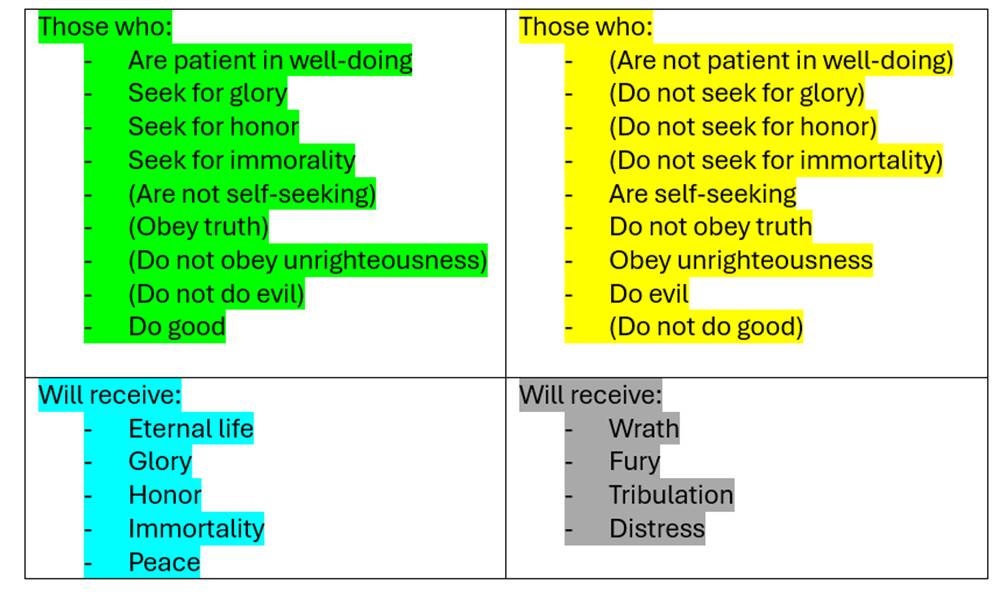
It sounds like Romans 2:6-11 is saying we are saved by our works. But that seems to contradict the rest of Romans (let alone the rest of Scripture!) What is going on?
- What is the general message of the broader context?
Paul seems to be making one main point in Romans 1:16-3:20, after his greetings and before he says “but now” in 3:21. The general message up to this point in his letter is that all men are condemned. To understand 2:6-11, then, you must understand that what Paul says there is to serve his broader point being made in the first three chapters in general—he brings up judgement based on works in order to support his conclusion that all men are condemned.
Paul’s argument up to 3:20 then is as follows:
- God’s judgement is based on righteousness. (2:6-11)
- All men are unrighteous.
- Therefore, all men are condemned.
- Does God judge based on works?
When Paul’s argument is laid out as in 2.a-c above you can see how integral Romans 2:6-11 is to his broader argument. Paul must express judgement by works to best convince his audience of their unworthiness before God. Any reader can tell that this is not where Paul leaves things—there is good news to come. Because of Christ, man does not need to suffer condemnation. Thank God for that! But does that mean Paul was just telling a bit of a white lie when he said “God will render to each according to their works”?
One might think the good news Paul begins to lay out in Romans 3:21 changes his original argument to this:
- Because of Jesus, God’s judgement is no longer based on righteousness.
- All men are unrighteous.
- Therefore, not all men are condemned.
The difficulties with this are that 1) if God’s judgement is no longer based on righteousness, it would seem that there is actually no judgement at all! All are saved and there is no longer justice with God.
And 2) it is not only this passage which speaks of God’s judgement being based on righteousness, it is the whole witness of Scripture:
- Leviticus 18:5 “You shall therefore keep my statutes and my rules; if a person does them, he shall live by them…”
- Deuteronomy 27:26 “Cursed be anyone who does not confirm the words of this law by doing them.”
- The blessing in Leviticus and curse in Deuteronomy are contingent upon doing the law. If you obey, then you live. If you disobey, then you are cursed. Which one does mankind fall under according to Paul in Romans 1-3? The curse, of course! That’s the “if” we have made reality.
- 1 Corinthians 3:10-15 “If the work that anyone has built on the foundation survives, he will receive a reward. If anyone’s work is burned up, he will suffer loss, though he himself will be saved, but only as through fire.”
- There are rewards from God for good work—although this passage is likely not teaching about our ultimate heavenly reward, it still illustrates a the principle that our reward is associated with our work.
- Proverbs 24:12 “[God] will repay man according to his work.”
- Matthew 16:27 Jesus said that he “will repay each person according to what he has done.”
- Matthew 5:20: “Unless your righteousness exceeds that of the scribes and Pharisees, you will never enter the kingdom of heaven.”
- Who followed the letter of the law better than these guys? No one! Who then can be saved? This is probably the very question Jesus wanted his audience to ask themselves. It’s what his disciples ended up asking him later on (Mt 19:25).
- Revelation 20:12 John sees “the dead judged…according to what they had done.”
- Whether some of the other passages on this list are about the highest and eternal reward in heaven or not, this one is certainly about final judgement to glory or damnation.
- Jeremiah 32:19 God is “rewarding each one according to his ways and according to the fruit of his deeds.”
- Galatians 5:16-21 Those who are led by the works of the flesh “will not inherit the Kingdom of God”.
- 2 Corinthians 5:10 “For we must all appear before the judgment seat of Christ, so that each one may receive what is due for what he has done in the body, whether good or evil.”
- Hebrews 11:6 “…whoever would draw near to God must believe that he exists and that he rewards those who seek him.”
- Matthew 5:48 Jesus said, “You therefore must be perfect, as your Heavenly Father is perfect.”
- The standard is perfection. None can be as mighty as the Father, of course; that isn’t what Jesus is saying. But the expectation is that our righteousness match his. What he’d have us think, say, and do—that we ought. His affections should be ours in every respect. His will in heaven ought to be done in our lives here on earth, and without any deviation from that.
- Acts 17:31”[God] has fixed a day on which he will judge the world in righteousness by a man whom he has appointed.”
These verses should be enough to convince the reader that our judgement is tied to our works. This is not the place to do a complete systematic exegesis of all the relevant verses on this subject and get into the nuances. The point is just that everyone, no matter who you are, is going to be in trouble if they stand before God and do not have righteousness to present.
So with all these verses from the rest of Scripture in mind, we can see that Paul really meant what he said in Romans 2:6-11. God truly will render to each one according to his works. If this is a terrifying thing, it should be—this is the effect Paul desired this truth to have. If God renders to each according to his righteousness and all men fall short, how can any be saved? This is exactly what Paul wants his readers to be asking themselves! He’s got his patient convinced of their disease, he has primed them to be willing to receive the cure which he’s got ready at hand.
- How man may be righteous.
For there to be good news that “not all men are condemned” something needs to be changed in Paul’s original argument (see point 2.a-c). But it’s obvious that God’s judgement does not change as we just saw above in point #3. But the only other point in Paul’s argument is that we are unrighteous. Is the good news actually that our righteousness changes such that we are able to satisfy all that God requires?
Here’s what the rest of Scripture says:
- Romans 3:21-22 “But now the righteousness of God has been manifested apart from the law, although the Law and Prophets bear witness to it—the righteousness of God through faith in Jesus Christ for all who believe.”
- Note that this is the very next verse after the passage we are considering. This is the very next thing Paul says after proving the condemnability of all mankind.
- Romans 4:5 “To the one who does not work but believes in him who justifies the ungodly, his faith is counted as righteousness.”
- The bill is still due, but there is a way for credit to be made to the account.
- Romans 6:6, 17 “We know that our old self was crucified with him in order that the body of sin might be brought to nothing, so that we would no longer be enslaved to sin…you who were once slaves of sin have become obedient from the heart to the standard of teaching to which you were committed, and, having been set free from sin, have become slaves of righteousness.”
- This certainly sounds like someone who meets the requirements Paul sets out in Romans 2:6-11. Our bankruptcy has been dismissed, all our bills have been cancelled, we’ve been won the lottery, and our money’s accruing interest faster than we can deposit it. Imagine Christ evaluating on judgement day whether you are righteous (based on the standards in Romans 2:6-11), looking at you and exclaiming “my goodness, you weren’t just righteous, you were a slave to righteousness! You couldn’t have had sin in your heart if you tried!”
- Romans 7:17, 22, 25 “So now it is no longer I who [sin] but the sin that dwells within me…For I delight in the law of God, in my inner being. So then, I myself serve the law of God with my mind, but in my flesh I serve the law of sin.”
- Paul here clarifies that, though as regenerated men our spirit is righteous, we retain old habits in our flesh which will not be completely redeemed until our resurrection.
- Romans 8:3-4 “For God has done what the law, weakened by the flesh, could not do. By sending his own Son in the likeness of sinful flesh and for sin, he condemned sin in the flesh, in order that the righteous requirement of the law might be fulfilled in us, who walk not according to the flesh but according to the Spirit.”
- Money is owed and we’re bankrupt, but there’s a benefactor who is able to pay the bill on our behalf.
- Hebrews 10:14, 16 “For by a single offering [Christ] has perfected for all time those who are being sanctified.” For in the Lord said of this time, “I will put my laws on their hearts and write them on their minds.”
- If you thought Jesus’ standard in Matthew 5:48 to “be perfect” was unrealistic, here is the proof that it is not—perfection is had through Christ’s offering of himself. Our perfection is not our own, it is his. We have an inward perfection, although we are continually being sanctified—that is, made more and more holy.
- 2 Corinthians 5:17, 21 “Therefore, if anyone is in Christ, he is a new creation. The old has passed away; behold, the new has come…For our sake he made him to be sin who knew no sin, so that in him we might become the righteousness of God.”
- Here is the great exchange. Christ took what we deserved, our punishment, and we were given what he deserved, his righteousness and glory.
- 1 Corinthians 1:30 “And because of him, you are in Christ Jesus, who became to us wisdom from God, righteousness and sanctification and redemption, so that, as it is written, ‘Let the one who boasts, boast in the Lord.’”
- Ephesians 4:24 “Put on the new self, created after the likeness of God in true righteousness and holiness.”
- This is not a pretend righteousness or a mere declaration—it is a real righteousness we are given.
- Colossians 3:9-10 “Do not lie to one another, seeing that you have put off the old self with its practices and have put on the new self, which is being renewed in knowledge after the image of its creator.”
- Philippians 3:9 “…and be found in him, not having a righteousness of my own that comes from the law, but that which comes through faith in Christ, the righteousness of God that depends on faith.”
- Righteousness is the standard, but the means of getting righteousness is not the law—for then we can boast that it is our own righteousness. But if it is a righteousness received through faith only then we are able to both meet the standard and be completely free of boasting since it is a righteousness that is not our own.
- Ezekiel 36:26-17, 29, 31 “And I will give you a new heart, and a new spirit I will put within you. And I will remove the heart of stone from your flesh and give you a heart of flesh. And I will put my Spirit within you, and cause you to walk in my statues and be careful to obey my rules…And I will deliver you from all your uncleannesses…Then you will remember your evil ways, and your deeds that were not good, and you will loath yourselves for your iniquities and your abominations.”
- All the previous references on this list are from the New Testament—this is where the plan is made clear because although “the law was given through Moses; grace and truth came through Jesus Christ…[who] is at the Father’s side, he has made him known (John 1:17-18).” But you can see here in Ezekiel that even in the Old Testament, the plan was being foretold.
So is Paul’s good news that God will ignore our unrighteousness and let us into heaven anyway? Not at all! Our unrighteousness is nailed to the cross and we are actually made righteous!
Here, then, is how Paul modified his original argument based on this good news:
- God’s judgment is based on righteousness.
- By faith in Christ, men can have the righteousness of God.
- Therefore, not all men are worthy of condemnation.
The gift is the righteousness. Heaven isn’t free—the cost is righteousness. Someone had to pay. Salvation is by works—just not our own. How much greater a thankfulness we ought to have knowing that God’s holy and righteous demands have not and will not change. Perfect holiness is required. And this demand is met by Christ’s gracious offering in us. Because God is good he cannot arbitrarily pardon sin and turn a blind eye to unrighteousness. “Your iniquities have made a separation between you and your God (Isa 59:2)”, “All his ways are justice (Deut 32:4)” and “I the LORD do not change (Mal 3:6)”. Our sin had to be paid for and we had to be given a perfect righteousness. The cross was God’s way to be both “just and justifier” (Rom 3:26). His grand plan is to show both his justice and his mercy (Rom 9:22-23). Those who receive wrath receive what they justly deserve because of their own unrighteousness. Those who receive reward and glory receive what is justly deserved because of the righteousness Christ has earned for those who are in him. No free passes are given. God cannot stand in the presence of unholiness. The degree of terror we ought to have had when recognizing this awful fact is the same degree we should be thankful and awestruck by his mercy. Our Lord came not to give out free tickets to heaven. He came to pay the cost of admission—at a great price. And now, thanks to God, “It is finished”—paid in full.
- Conclusion.
Let’s review Romans 2:6-11 broken down once more:
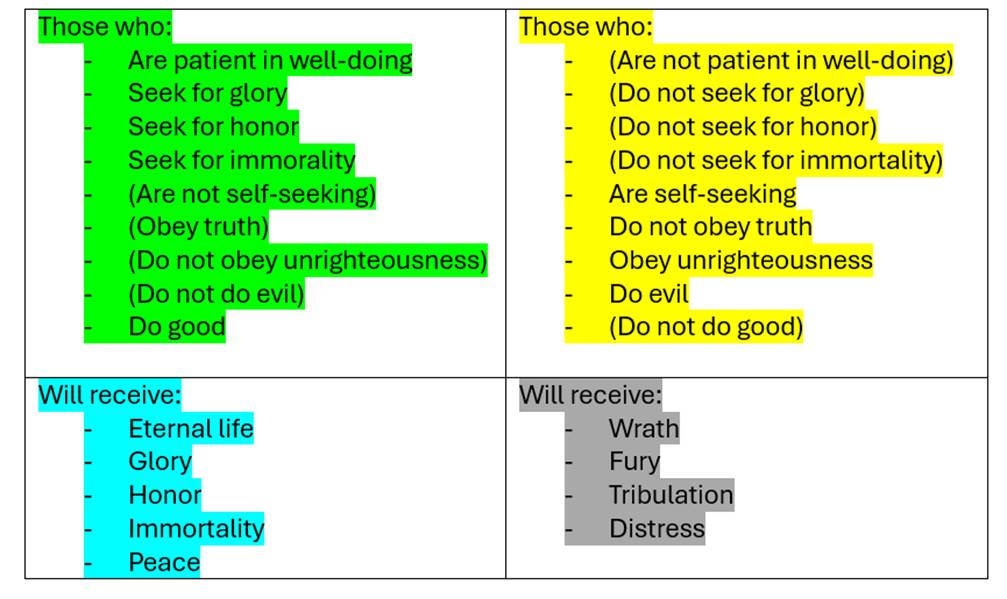
After having looked at the rest of Scripture, we can understand now that the green box is what Paul calls elsewhere “the fruit of the Spirit” (Gal 5:22-23). No one whose character is such that it is not able to bear the fruit of the Spirit will receive the inheritance of the Spirit. In order to convict his readers that they need to be made a new tree, he has to focus on the kind of fruit they’re bearing. “Are grapes gathered from thornbushes, or figs from thistles? So, every healthy tree bears good fruit, but the diseased tree bears bad fruit…Thus you will recognize them by their fruits (Mt. 7:16-17, 20).” But the solution, as we have seen above, is not for the thistle to start bearing figs. The solution is for the thistle to be uprooted, destroyed, and replanted as a fig. That’s what happens in the new birth—we are not made better, our lives aren’t changed—we’re made new.
So our very being needs to reflect the description of the green box. This can only be said of us once we have been reborn “after the likeness of God in true righteousness”. The green box must be said of us or we will not receive the blue box. Paul says it and he means it. But to get the fruit of the Spirit, you must have the Spirit, and we “receive the promised Spirit through faith” (Gal 3:14).
- Final Note of Encouragement.
If your life has not been changed, if your sin still has the same control over your life as when you first believed, you may be like “the demons [who] believe—and shudder! (Ja 2:19)”. Being a grape vine looks different than being a thornbush. But good fruit is God’s grace to us; by it we have the great blessing to be able to test our own hearts, as Paul exhorts elsewhere to “examine yourselves, to see whether you are in the faith” (2 Co 13:5). And, although we cannot see into anyone else’s heart, by their fruit we can have a pretty good indication of who are true brothers to be received in love and who are false brothers of whom we should be suspicious. It is of these latter whom Jude speaks as “hidden reefs at your love feasts…shepherds feeding themselves; waterless clouds, swept along by the winds; fruitless trees in late autumn, twice dead, uprooted. (Ju 12)” Thank God we are given a means by which to detect an abusive and unregenerate Sunday school teacher!
The fruit of the Spirit is a blessing not a burden. For Jesus says, “I will give you rest…For my yoke is easy, and my burden is light (Matt 11:28-30).” Scripture teaches that we grow in our sanctification (Philip 3:12-14). If we are growing, that means our lives look more righteous now than they were; if our lives will be more righteous in our coming years, that means we are less righteous now than we could be. There are levels of spiritual maturity so we ought to give grace to one another and not hold each other to a law, which undoes Christ’s work. A grapevine at full maturity will bear more fruit than a newly planted grapevine. Trees may go through a period of poor yield before a well-deserved pruning. But just like the parable of the laborers who all started work at a different time in the day and ended at the same time, all are rewarded equally for having been in the employ of the generous master (Matt 20:1-16). Notice how Paul does not lay out specific commandments or give a checklist to accomplish in order to verify in others whether they have met the requirements. This would be to make a new law, which he clearly condemns as being the opposite of what we need or what God requires! The standards Paul lays out is enough for us to examine ourselves. He paints a picture of the character of the regenerated—he does not give a checklist of items to accomplish or abstain from in order to make it into heaven.

Did this study help you to better understand Romans or the gospel message? I’d sure love to hear about it! Comment your thoughts below. God bless!
 Name the Unknown