
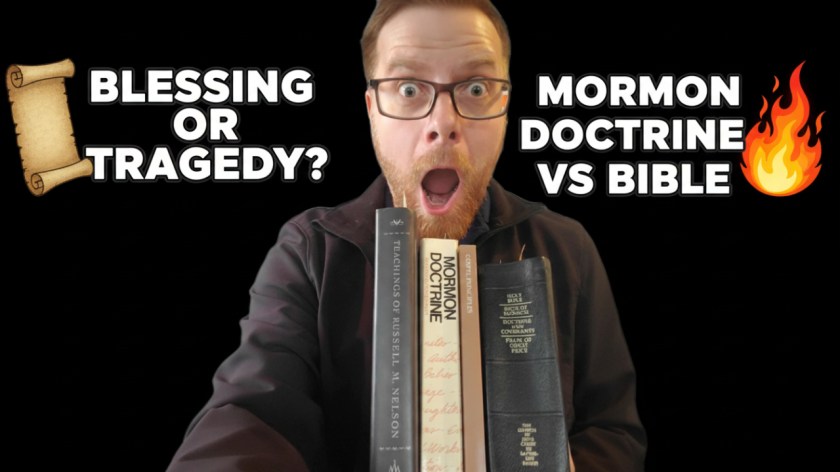
Was the Fall of Adam and Eve a blessing or a tragedy? In my recent video, I explore how the Church of Jesus Christ of Latter-day Saints (LDS) teaches that the Fall was a good and necessary event — and why, from a biblical perspective, that view contradicts Scripture’s message about sin and salvation.
As a companion to the video, this post will include the quotes cited for you to read and link you to the full source for more context (not available for all sources).
The Church of Jesus Christ of Latter-day Saints often describes the Fall as a “fortunate” or “necessary step forward”—even a blessing that made human progression possible. You’ll hear direct quotes from official LDS sources and church leaders explaining why they view the Fall as a positive event.
Then, we open the Bible together to see what Scripture actually says about humanity’s fall into sin, separation from God, and our need for redemption through Christ alone.
👉 Topics covered:
- Why LDS teachings celebrate the Fall as “a step toward godhood”
- How this view contrasts with Genesis 3, Romans 5, and other key passages
- What the Fall truly means for sin, salvation, and the gospel
- Why a biblical understanding of grace and redemption matters today
Whether you’re a member of the LDS Church, exploring Mormon theology, or simply seeking to understand what the Bible teaches about sin and salvation, the video will help you compare these two worldviews side-by-side with clarity and respect.
🗂 LDS sources referenced
2 Nephi 2:10-25, Ester 3:2, Moses 5:10-11, D&C 29:39-41 (see also Alma 22:12-14 and Alma 42), Gospel Principles (Ch. 6, pg. 33-34), Teachings of Russell M. Nelson (“Fall of Adam”, pg. 110), Mormon Doctrine by Bruce R. McConkie (“Fall of Adam”, pg. 268)
10 And because of the intercession for all, all men come unto God; wherefore, they stand in the presence of him, to be judged of him according to the truth and holiness which is in him. Wherefore, the ends of the law which the Holy One hath given, unto the inflicting of the punishment which is affixed, which punishment that is affixed is in opposition to that of the happiness which is affixed, to answer the ends of the atonement—
11 For it must needs be, that there is an opposition in all things. If not so, my firstborn in the wilderness, righteousness could not be brought to pass, neither wickedness, neither holiness nor misery, neither good nor bad. Wherefore, all things must needs be a compound in one; wherefore, if it should be one body it must needs remain as dead, having no life neither death, nor corruption nor incorruption, happiness nor misery, neither sense nor insensibility.
12 Wherefore, it must needs have been created for a thing of naught; wherefore there would have been no purpose in the end of its creation. Wherefore, this thing must needs destroy the wisdom of God and his eternal purposes, and also the power, and the mercy, and the justice of God.
13 And if ye shall say there is no law, ye shall also say there is no sin. If ye shall say there is no sin, ye shall also say there is no righteousness. And if there be no righteousness there be no happiness. And if there be no righteousness nor happiness there be no punishment nor misery. And if these things are not there is no God. And if there is no God we are not, neither the earth; for there could have been no creation of things, neither to act nor to be acted upon; wherefore, all things must have vanished away.
14 And now, my sons, I speak unto you these things for your profit and learning; for there is a God, and he hath created all things, both the heavens and the earth, and all things that in them are, both things to act and things to be acted upon.
15 And to bring about his eternal purposes in the end of man, after he had created our first parents, and the beasts of the field and the fowls of the air, and in fine, all things which are created, it must needs be that there was an opposition; even the forbidden fruit in opposition to the tree of life; the one being sweet and the other bitter.
16 Wherefore, the Lord God gave unto man that he should act for himself. Wherefore, man could not act for himself save it should be that he was enticed by the one or the other.
17 And I, Lehi, according to the things which I have read, must needs suppose that an angel of God, according to that which is written, had fallen from heaven; wherefore, he became a devil, having sought that which was evil before God.
18 And because he had fallen from heaven, and had become miserable forever, he sought also the misery of all mankind. Wherefore, he said unto Eve, yea, even that old serpent, who is the devil, who is the father of all lies, wherefore he said: Partake of the forbidden fruit, and ye shall not die, but ye shall be as God, knowing good and evil.
19 And after Adam and Eve had partaken of the forbidden fruit they were driven out of the garden of Eden, to till the earth.
20 And they have brought forth children; yea, even the family of all the earth.
21 And the days of the children of men were prolonged, according to the will of God, that they might repent while in the flesh; wherefore, their state became a state of probation, and their time was lengthened, according to the commandments which the Lord God gave unto the children of men. For he gave commandment that all men must repent; for he showed unto all men that they were lost, because of the transgression of their parents.
22 And now, behold, if Adam had not transgressed he would not have fallen, but he would have remained in the garden of Eden. And all things which were created must have remained in the same state in which they were after they were created; and they must have remained forever, and had no end.
23 And they would have had no children; wherefore they would have remained in a state of innocence, having no joy, for they knew no misery; doing no good, for they knew no sin.
24 But behold, all things have been done in the wisdom of him who knoweth all things.
25 Adam fell that men might be; and men are, that they might have joy.
—
2 O Lord, thou hast said that we must be encompassed about by the floods. Now behold, O Lord, and do not be angry with thy servant because of his weakness before thee; for we know that thou art holy and dwellest in the heavens, and that we are unworthy before thee; because of the fall our natures have become evil continually; nevertheless, O Lord, thou hast given us a commandment that we must call upon thee, that from thee we may receive according to our desires.
—
10 And in that day Adam blessed God and was filled, and began to prophesy concerning all the families of the earth, saying: Blessed be the name of God, for because of my transgression my eyes are opened, and in this life I shall have joy, and again in the flesh I shall see God.
11 And Eve, his wife, heard all these things and was glad, saying: Were it not for our transgression we never should have had seed, and never should have known good and evil, and the joy of our redemption, and the eternal life which God giveth unto all the obedient.
—
39 And it must needs be that the devil should tempt the children of men, or they could not be agents unto themselves; for if they never should have bitter they could not know the sweet—
40 Wherefore, it came to pass that the devil tempted Adam, and he partook of the forbidden fruit and transgressed the commandment, wherein he became subject to the will of the devil, because he yielded unto temptation.
41 Wherefore, I, the Lord God, caused that he should be cast out from the Garden of Eden, from my presence, because of his transgression, wherein he became spiritually dead, which is the first death, even that same death which is the last death, which is spiritual, which shall be pronounced upon the wicked when I shall say: Depart, ye cursed.
—
Alma 22:12-14 (referenced, but not quoted in the video)
12 And it came to pass that when Aaron saw that the king would believe his words, he began from the creation of Adam, reading the scriptures unto the king—how God created man after his own image, and that God gave him commandments, and that because of transgression, man had fallen.
13 And Aaron did expound unto him the scriptures from the creation of Adam, laying the fall of man before him, and their carnal state and also the plan of redemption, which was prepared from the foundation of the world, through Christ, for all whosoever would believe on his name.
14 And since man had fallen he could not merit anything of himself; but the sufferings and death of Christ atone for their sins, through faith and repentance, and so forth; and that he breaketh the bands of death, that the grave shall have no victory, and that the sting of death should be swallowed up in the hopes of glory; and Aaron did expound all these things unto the king.
—
Alma 42:1-16 (referenced, but not quoted in video; the rest of the chapter continues the thought and would be helpful to read for a fuller understanding)
1 And now, my son, I perceive there is somewhat more which doth worry your mind, which ye cannot understand—which is concerning the justice of God in the punishment of the sinner; for ye do try to suppose that it is injustice that the sinner should be consigned to a state of misery.
2 Now behold, my son, I will explain this thing unto thee. For behold, after the Lord God sent our first parents forth from the garden of Eden, to till the ground, from whence they were taken—yea, he drew out the man, and he placed at the east end of the garden of Eden, cherubim, and a flaming sword which turned every way, to keep the tree of life—
3 Now, we see that the man had become as God, knowing good and evil; and lest he should put forth his hand, and take also of the tree of life, and eat and live forever, the Lord God placed cherubim and the flaming sword, that he should not partake of the fruit—
4 And thus we see, that there was a time granted unto man to repent, yea, a probationary time, a time to repent and serve God.
5 For behold, if Adam had put forth his hand immediately, and partaken of the tree of life, he would have lived forever, according to the word of God, having no space for repentance; yea, and also the word of God would have been void, and the great plan of salvation would have been frustrated.
6 But behold, it was appointed unto man to die—therefore, as they were cut off from the tree of life they should be cut off from the face of the earth—and man became lost forever, yea, they became fallen man.
7 And now, ye see by this that our first parents were cut off both temporally and spiritually from the presence of the Lord; and thus we see they became subjects to follow after their own will.
8 Now behold, it was not expedient that man should be reclaimed from this temporal death, for that would destroy the great plan of happiness.
9 Therefore, as the soul could never die, and the fall had brought upon all mankind a spiritual death as well as a temporal, that is, they were cut off from the presence of the Lord, it was expedient that mankind should be reclaimed from this spiritual death.
10 Therefore, as they had become carnal, sensual, and devilish, by nature, this probationary state became a state for them to prepare; it became a preparatory state.
11 And now remember, my son, if it were not for the plan of redemption, (laying it aside) as soon as they were dead their souls were miserable, being cut off from the presence of the Lord.
12 And now, there was no means to reclaim men from this fallen state, which man had brought upon himself because of his own disobedience;
13 Therefore, according to justice, the plan of redemption could not be brought about, only on conditions of repentance of men in this probationary state, yea, this preparatory state; for except it were for these conditions, mercy could not take effect except it should destroy the work of justice. Now the work of justice could not be destroyed; if so, God would cease to be God.
14 And thus we see that all mankind were fallen, and they were in the grasp of justice; yea, the justice of God, which consigned them forever to be cut off from his presence.
15 And now, the plan of mercy could not be brought about except an atonement should be made; therefore God himself atoneth for the sins of the world, to bring about the plan of mercy, to appease the demands of justice, that God might be a perfect, just God, and a merciful God also.
16 Now, repentance could not come unto men except there were a punishment, which also was eternal as the life of the soul should be, affixed opposite to the plan of happiness, which was as eternal also as the life of the soul.
—
Gospel Principles Ch. 6, pg. 33-34 in print (the strikethrough text is in the 1997 official print version, but has since been removed in the most current official version online as of 2025)
“Because Adam and Eve had eaten the fruit of the tree of knowledge of good and evil, the Lord sent them out of the Garden of Eden into the world as we know it. Their physical condition changed as a result of their eating the forbidden fruit. As God had promised, they became mortal. They were able to have children. They and their children would experience sickness, pain, and physical death.
Because of their transgression, Adam and Eve also suffered spiritual death. This meant they and their children could not walk and talk face to face with God. Because Satan had introduced evil into the world, Adam and Eve and their children were separated from God both physically and spiritually.
Some people believe Adam and Eve committed a serious sin when they ate of the tree of knowledge of good and evil. However, latter-day scriptures help us understand that their Fall was a necessary step in the plan of life and a great blessing to all of us. Because of the Fall, we are blessed with physical bodies, the right to choose between good and evil, and the opportunity to gain eternal life. None of these privileges would have been ours had Adam and Eve remained in the garden.
—
Teachings of Russell M. Nelson,“Fall of Adam”, pg. 110 (In my video, I present from the Deseret print—unavailable for online reference, not the official LDS church book of the same title which is an entirely different work. The book I use provides the original reference which is from this 1993 talk by Nelson—this quote found under “The Fall” heading—which I’ve hunted down since the video and so provide a fuller quote below.)
“We and all mankind are forever blessed because of Eve’s great courage and wisdom. By partaking of the fruit first, she did what needed to be done. Adam was wise enough to do likewise. Accordingly, we could speak of the fall of Adam in terms of a mortal creation, because ‘Adam fell that men might be’ (2 Ne. 2:25).
Other blessings came to us through the Fall. It activated two closely coupled additional gifts from God, nearly as precious as life itself—agency and accountability. We became ‘free to choose liberty and eternal life … or to choose captivity and death’ (2 Ne. 2:27). Freedom of choice cannot be exercised without accountability for choices made.”
—
Mormon Doctrine by Bruce R. McConkie ,“Fall of Adam” (pg. 194 in PDF version linked, pg. 268 in 8th printing)
“According to the foreordained plan, Adam was to fall; that is, ‘in the wisdom of him who knoweth all things’ (2 Ne. 2:24), Adam was to introduce mortality and all that attends it, so that the opportunity for eternal progression and perfection might be offered to all the spirit children of the Father.”
—
📖 New Testament Scriptures cited
Romans 5:12-19, Romans 6:1, Romans 3:5-8, 2 Corinthians 11:3, Acts 2:22-23 (see also Genesis 3)
(links to parallel Bible used in headings to aid understanding of KJV text copied below, links to LDS site provided at end of each passage)
12 Wherefore, as by one man sin entered into the world, and death by sin; and so death passed upon all men, for that all have sinned:
13 (For until the law sin was in the world: but sin is not imputed when there is no law.
14 Nevertheless death reigned from Adam to Moses, even over them that had not sinned after the similitude of Adam’s transgression, who is the figure of him that was to come.
15 But not as the offence, so also is the free gift. For if through the offence of one many be dead, much more the grace of God, and the gift by grace, which is by one man, Jesus Christ, hath abounded unto many.
16 And not as it was by one that sinned, so is the gift: for the judgment was by one to condemnation, but the free gift is of many offences unto justification.
17 For if by one man’s offence death reigned by one; much more they which receive abundance of grace and of the gift of righteousness shall reign in life by one, Jesus Christ.)
18 Therefore as by the offence of one judgment came upon all men to condemnation; even so by the righteousness of one the free gift came upon all men unto justification of life.
19 For as by one man’s disobedience many were made sinners, so by the obedience of one shall many be made righteous.
(Romans 5 on official LDS website)
—
1 What shall we say then? Shall we continue in sin, that grace may abound?
2 God forbid.
(Romans 6 on official LDS website)
—
5 But if our unrighteousness commend the righteousness of God, what shall we say? Is God unrighteous who taketh vengeance? (I speak as a man)
6 God forbid: for then how shall God judge the world?
7 For if the truth of God hath more abounded through my lie unto his glory; why yet am I also judged as a sinner?
8 And not rather, (as we be slanderously reported, and as some affirm that we say,) Let us do evil, that good may come? whose damnation is just.
(Romans 3 on official LDS website)
—
3 But I fear, lest by any means, as the serpent beguiled Eve through his subtilty, so your minds should be corrupted from the simplicity that is in Christ.
4 For if he that cometh preacheth another Jesus, whom we have not preached, or if ye receive another spirit, which ye have not received, or another gospel, which ye have not accepted, ye might well bear with him.
(2 Corinthians 11 on official LDS website)
—
22 Ye men of Israel, hear these words; Jesus of Nazareth, a man approved of God among you by miracles and wonders and signs, which God did by him in the midst of you, as ye yourselves also know:
23 Him, being delivered by the determinate counsel and foreknowledge of God, ye have taken, and by wicked hands have crucified and slain:
(Acts 2 on official LDS website)
—
See also Genesis 3, referenced but not quoted in the video.
(Genesis 3 on official LDS website)

I’m curious to hear from both those readers who are members of the Church of Jesus Christ of Latter-day Saints and those who are not—were you aware of this teaching of the LDS church? What do you think of this teaching and how its squares with the New Testament?
Comment below or shoot me a private message!
 Name the Unknown